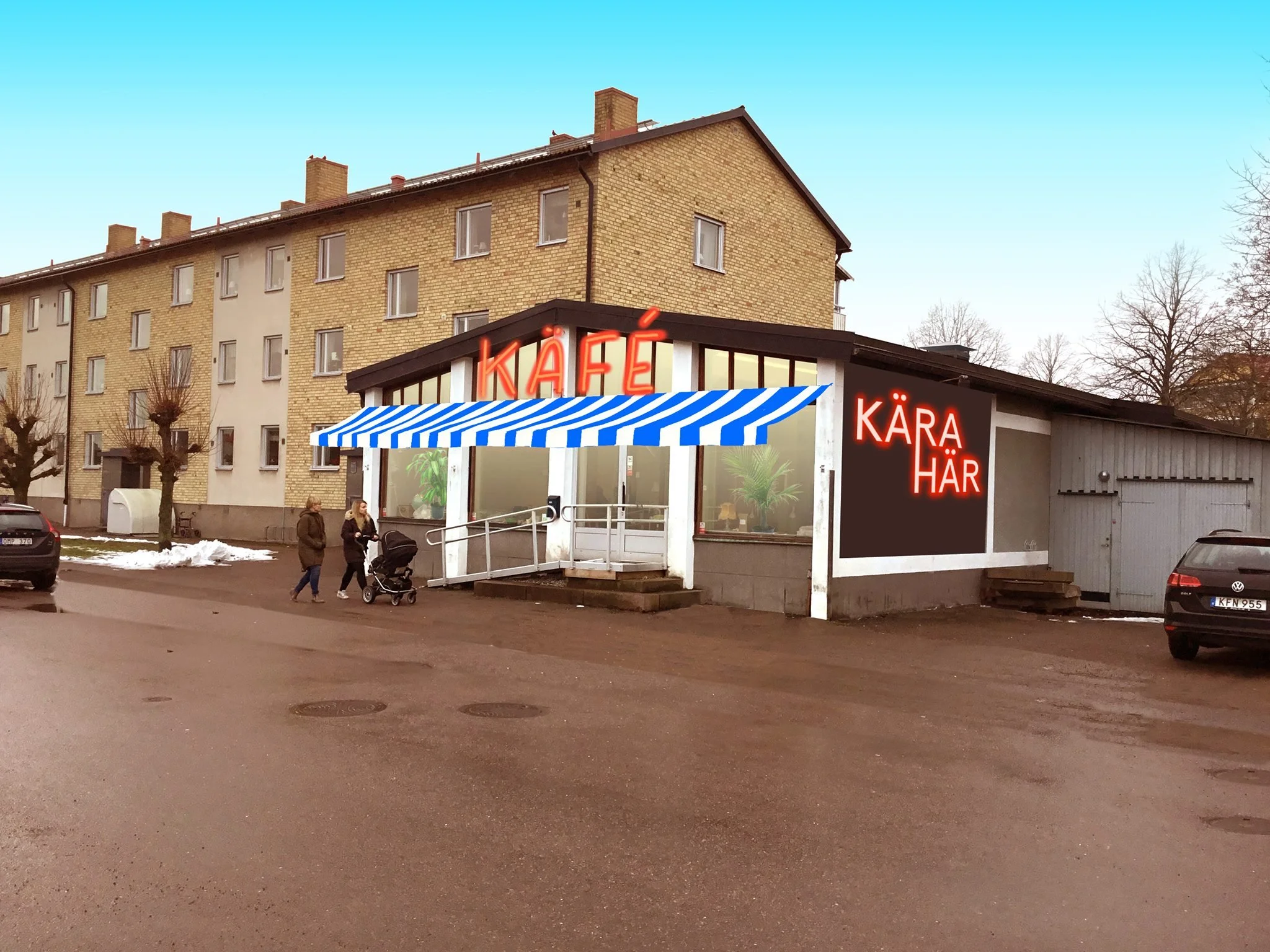
Kärahär
Kärahär was a community based project, initiated by Egill Sæbjörnsson & Andreas Brändström within the frame of The Swedish Arts Council’s (Kulturrådet) project Creative Places (Kreativa Platser) for giving groups of individuals in society with a lesser strong cultural voice, a stage to perform on. As a cooperating partner they chose a women based community group called Kvinnor tilsammans. Supporting instututions were NBV Värmland, IOGT and Riksteatern Värmland.
The idea was to invite different groups of people in the town Kristinehamn in Sweden, to come together and design and build a café & a restaurant where everything would be made from scratch; the furniture, the food utensils (ceramics), the food would partly be home grown in greenhouses and different cuisins would end up bringing people together, locals and new comers.
The name “Kärahär” is a play with language. It shows the interconnectedness between cultures that at first seem far apart but have strong cultural roots. The city Kandahar in Afghanistan might mean “A place where it’s good to be”, Kanda = Kind, Har = Here. Kandahar might be translated as “Kind here.” In Swedish that can be translated into Kär and här, or Kärahär. Many of the people that participated in the project were originally from Afghanistan, Syria, Irak, Iran and other countries.
The project ran from 2017 for three years until it’s funding took end in 2019. Then Kvinnor tilsammans and IOGT Sweden took over and ran it until 2021. Due to Covid and other reasons it ended it’s service.
“Creative Places focused on parts of the country where involvement in arts and culture was significantly below the national average. “We believe that everyone has the right to experience and be inspired by art, so we want to transform the opportunities open to people in those places” was they mindset. Creative Places aimed to create a sustainable community environment, particularly for asylum seekers, involving a community-managed greenhouse, a ceramics studio, workshop for all kinds of courses, a help center and a café-restaurant.
Other team members:
Naja Brakat - Project Leader (Kvinnor til sammans)
Linda Henriksson, Kristin Ericson & Jan Bingegård (Local Hired Project Managers)
Leif Person, Rikstheatern Värmland
Winnie Blom-Jensen, IOGT
Anneli Erikson, NBV Värmland
Edda Katrín Ragnarsdóttir