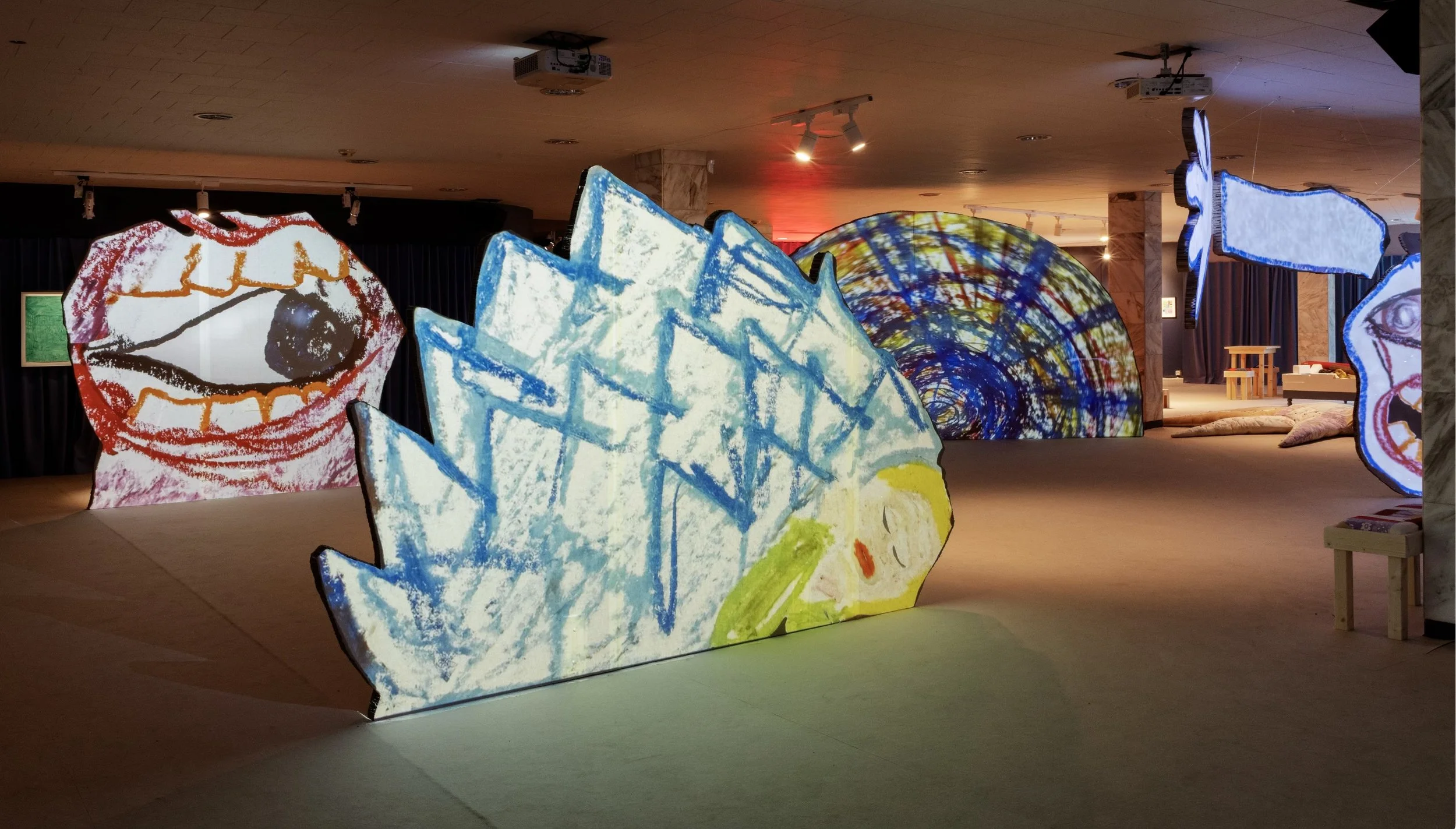
Egill Sæbjörnsson, Ágústa Oddsdóttir & Mosi Krisjáns. Pain & other recyclables. Survival Kit 17 Festival. Cur: Simona Dvorák & Elena Sorokina. Photo: Kristīne Madjāre
The Walk in Picture
Front Side.
The panels that you see in the image above are from pictures that Ágústa Oddsdóttir made during art therapy sessions with Sigríður Björnsdóttir 1988-1992. In them, she visited and faced her fears, losses and hopes, connected to her childhood. When she was a young teenager, her mother, Elín Jónsdóttir, had given up eating and speaking and was taken away to a Mental Hospital. Ágústa experienced insecurity, negative silent observations from the environment and gossip that affected her adult self image later on. In the therapy, she delved into memories, often not knowing what she was drawing, and slowly over a course of a few years, she started feeling better, “the anguish and the anger had receded” she says, and her whole existence was more at peace.
“I could not understand the magic that happened in the therapy with Sigríður and that’s when I started making the book”, Ágústa says, and years later her book, Art Can Heal, about the life and work of the woman that had done so much for her, was published by König Books in Cologne, Germany.
So, back to the panels in the picture above. Visitors could walk into the picture, mostly showing difficult elements from Ágústa’s youth, that could also be experiences by countless other people, as the human experience is so similar a large. The panels showed the frozen hedgehog, that Ágústa describes as “to be frozen was an easy way not to deal with things, my emotions and the reality of my life”, the Giant Eye “as if there was someone constantly watching”, “The Hand” that also wanted to grab and take away things and in the back “The Swirl” that represents the feeling of the silence around the events in her childhood home, that were overwhelming and somehow turned her whole existence upside down, but so slowly that she could never pinpoint what it was.
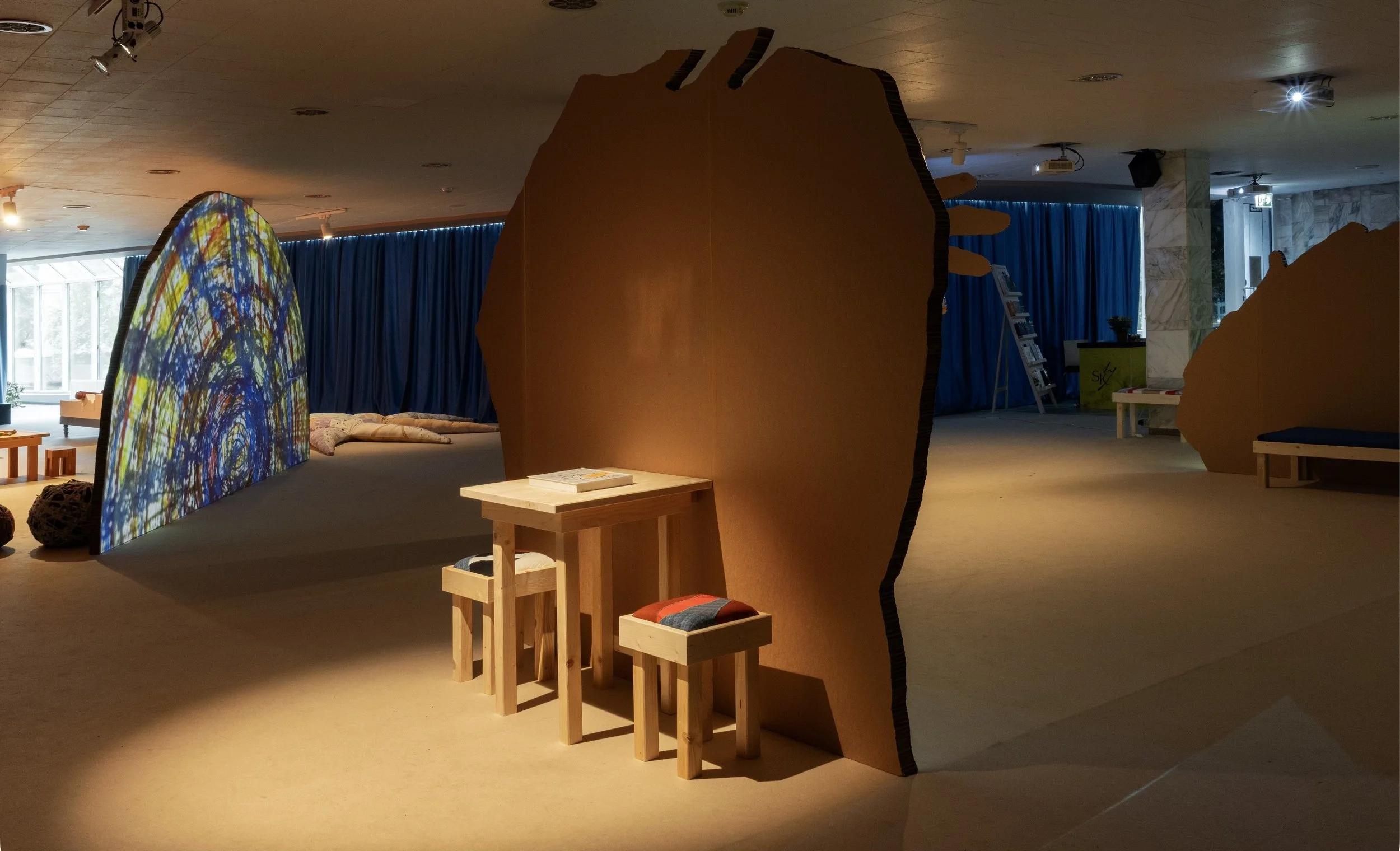
Egill Sæbjörnsson, Ágústa Oddsdóttir & Mosi Krisjáns. Pain & other recyclables. Survival Kit 17 Festival. Cur: Simona Dvorák & Elena Sorokina. Photo: Kristīne Madjāre
Back side
When you had entered the picture, you saw tables and chairs on the back side of the panels. There you could sit down, draw, talk and drink coffee.
This represents the recycling part, or the therapeutic part, that art can offer.
The way Sigríður Björnsdóttir employed art, starting in 1952, was to offer a safe space to individuals, give them means to draw with, to explore their inner world, feelings and emotions, create a picture or express themselves and later explain perhaps what the picture meant.
In that way, art as a commodity to heal our inner wounds, was explored, and with her method, mostly with sick children in hospitals, a new field came into existence, art-therapy. Sigríður Björnsdóttir first called it Picture-therapy or Play-therapy. But later the world chose “Art-Therapy”.
This project that we created for The Survival Kit 17 Festival, this “Walk-In-Picture” is in a simplified way a methaphor for art therapy. But as art therapy is often categorised as something of the medicine world and not as part of the art world, we prefer talking about Sigríður Björnsdóttir and her methods as artistic methods. She was decades ahead of her times, as now we see more and more younger artists working with art as a modality of care and present their work in art institutions. At the time Sigríður was developing her approach to art, she didn’t work in those spaces, she worked in school rooms of hospitals for sick children. Her work started in London, and later she had her own department at The Landspítali Hospital in Iceland.
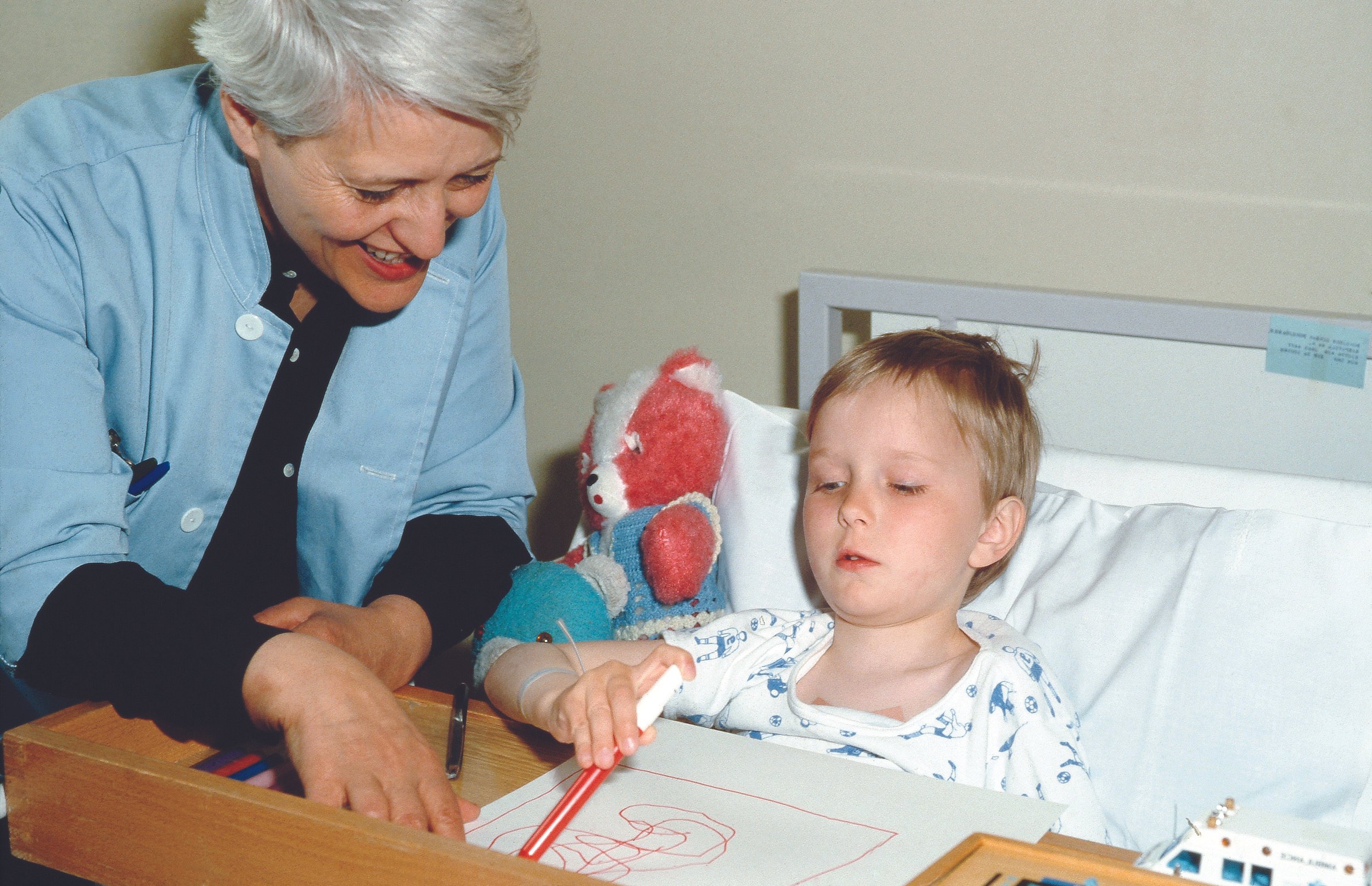
Sigríður Björnsdóttir working with a child in a hospital. Date and photographer unknown